
The debate about working from home often puts preferences, productivity and retention into one argument. A well-defined experiment can separate some of those questions.
The experiment in brief
A 2024 paper in Nature reports a six-month randomized trial involving 1,612 graduate employees at Trip.com in China during 2021–2022. One group could work from home two days a week; the comparison group worked in the office all five days.
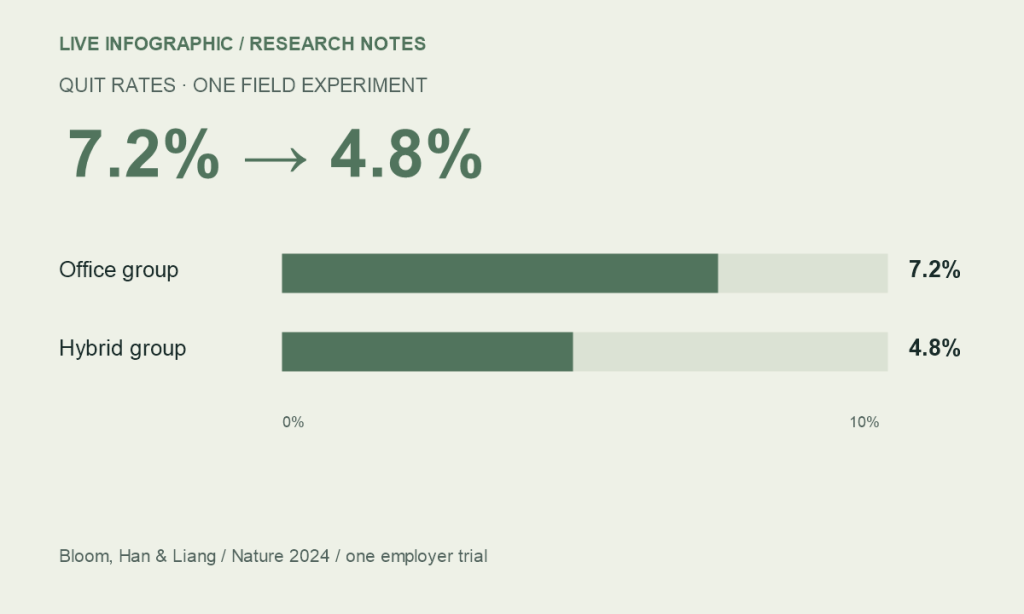
Quit rates were 7.2% in the office group and 4.8% in the hybrid group, a difference of 2.4 percentage points, or one-third relative to the office group’s rate. The study found no evidence of damage to the performance and promotion outcomes it examined. It does not establish the effect of fully remote work in every occupation.
| Group | Work arrangement | Quit rate |
|---|---|---|
| Office | Five days in office | 7.2% |
| Hybrid | Option of two home days | 4.8% |
Why random assignment matters
In an ordinary comparison, people who choose remote work may differ from people who prefer the office. A randomized design makes the groups more comparable at the outset, strengthening the case for attributing a difference to the arrangement tested.
Even so, the result has boundaries. The employer, job types, local setting and schedule are part of the experiment. A hospital ward, a warehouse and a software team face different coordination constraints. Reusing the headline without its setting can turn a useful result into an unsupported promise.
Separate outcomes before changing policy
- Retention: who stays, and over what period?
- Performance: which outputs or review criteria are measured?
- Coordination: where does handover fail or become slower?
- Experience: how do employees describe the arrangement?
A practical evaluation starts by naming the job and the problem. If the problem is an expensive commute, office attendance is a different intervention from improving documentation. If the problem is delayed handovers, the relevant measure may be response time rather than a satisfaction score.
Make the comparison fair
Define outcomes before the pilot, use the same evaluation criteria for both groups and keep track of changes in workload. Record which tasks require shared presence and which can be done independently. A mixed result may reveal that one schedule works for some tasks and not others.
The lesson is methodological as much as operational: ask what was tested, against what alternative, and in which setting. Those questions also help distinguish a genuine trial from a collection of anecdotes.
Source & methodology
Bloom, Han & Liang · Nature (2024). Source checked October 6, 2026. Figures are attributed to the stated period; this is an explainer, not a live data feed. Interpretation and illustrative examples are identified in the text.
See our editorial policy for sourcing and corrections.