
An answer can be useful to a searcher while changing the route to the website that supplied it. That tension sits at the center of the debate over AI summaries in search.
What the study measured
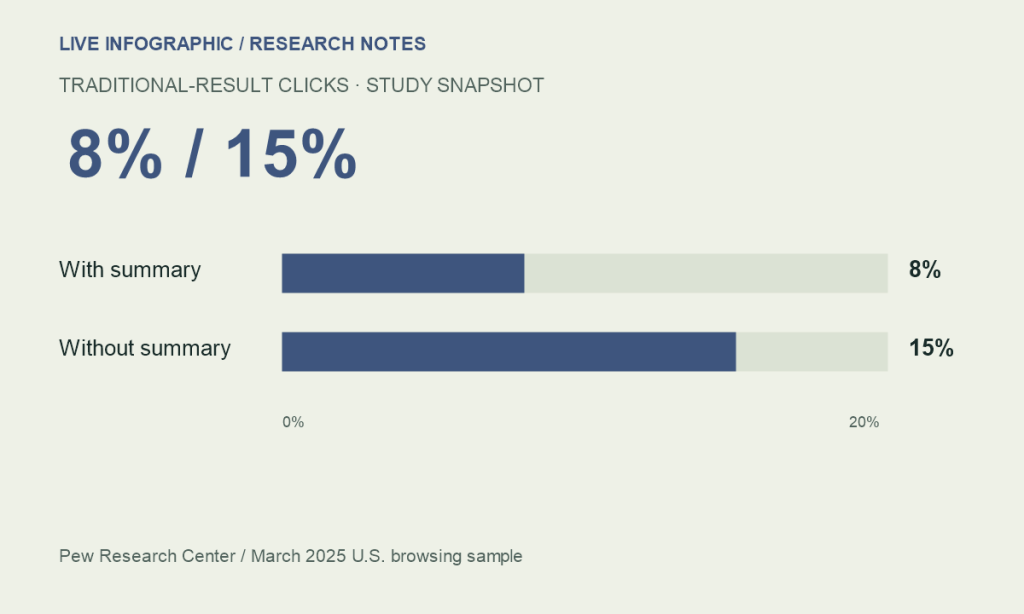
Pew Research Center studied browsing data from 900 U.S. adults in March 2025. Searches with an AI summary were associated with clicks on traditional result links in 8% of visits, compared with 15% for searches without a summary. Clicks on links inside the summaries occurred in about 1% of visits with a summary.
| Search-result page | Traditional-result click rate |
|---|---|
| AI summary present | 8% |
| No AI summary | 15% |
The comparison is observational. Queries that trigger a summary may differ from those that do not. Pew reconstructed results in April for searches observed in March. The findings are a dated U.S. sample, not a universal click forecast or proof that summaries alone caused the difference.
Separate visibility from visits
A publisher can be mentioned in an answer without receiving a website visit. A website visit can arrive without turning into a subscription, inquiry or sale. Treating these as one metric makes it difficult to diagnose what changed.
A useful measurement plan separates search impressions, clicks, landing-page engagement and meaningful outcomes. If impressions hold steady while clicks decline, the next question is which query groups moved. If visits decline while outcomes remain stable, the loss may involve a different audience from the one that usually converts.
Build around the reason to go deeper
A short definition is easy to summarize. An original comparison, a clearly documented dataset or a practical calculator may give a reader a reason to continue. This is an editorial hypothesis, not a ranking guarantee.
- Make the source of each claim easy to inspect.
- Show where estimates end and interpretation begins.
- Offer detail that answers the reader’s next question.
- Compare like-for-like query groups over a stable period.
What to avoid
Do not apply a single study’s percentages directly to a whole site’s revenue. Search intent, geography, device and page type can all change the relationship between visibility and traffic. A comparison of this month’s total with last month’s total may also hide seasonality.
For a small publication, a modest measurement sheet can be enough: record the date, query family, landing page, impressions, clicks and intended reader action. Consistent definitions are more useful than a large collection of disconnected screenshots.
Source & methodology
Pew Research Center · Google search behavior, July 2025. Source checked October 6, 2026. Figures are attributed to the stated period; this is an explainer, not a live data feed. Interpretation and illustrative examples are identified in the text.
See our editorial policy for sourcing and corrections.