
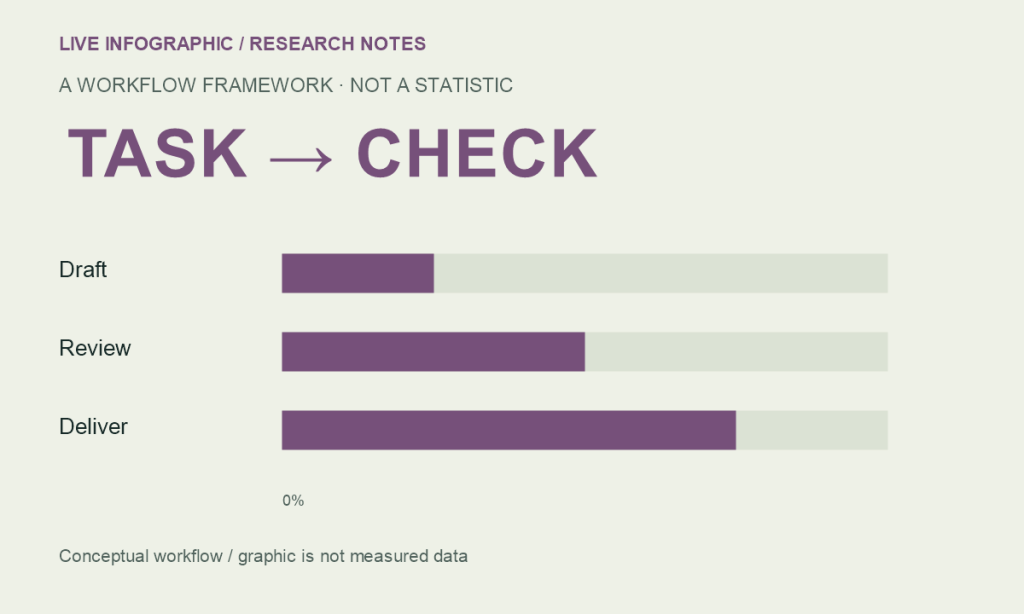
A business can subscribe to an AI tool in minutes. Finding a repeatable task that benefits from it takes more careful work.
What the research covers
The OECD’s 2025 report on generative AI and the SME workforce draws on a representative 2024 survey of more than 5,000 small and medium-sized enterprises in Austria, Canada, Germany, Ireland, Japan, Korea and the United Kingdom. Its scope matters: this is evidence from those countries and that survey period, rather than a census of all small businesses worldwide.
This article uses the report as context and offers an original workflow framework. It does not claim a measured return on investment from any particular AI product.
Start with the task, not the subscription
Choose a narrow task with a recognizable input and output. Turning meeting notes into a draft action list is easier to evaluate than “improving operations.” A first trial should have a person responsible for checking the result and a clear way to compare it with the current process.
| Task | Potential use | Check before delivery |
|---|---|---|
| Marketing draft | Produce alternative openings | Claims, voice and permissions |
| Customer-response draft | Suggest a clear explanation | Account facts and policy |
| Internal notes | Organize information | Missing decisions and owners |
| Spreadsheet assistance | Explain a proposed formula | Results against known cases |
Count review time
If drafting becomes faster but checking becomes slower, the net saving may be small. Record time spent preparing the input, reviewing the output, correcting mistakes and delivering the final version. Measure the entire workflow rather than one impressive step.
Quality needs a definition too. A draft that sounds polished but gets a product specification wrong creates rework. A useful checklist asks whether the result is accurate, complete, appropriate for the audience and safe to share.
Set boundaries before the pilot
- Choose what information the tool may receive.
- Keep confidential customer or employee details out of an unapproved workflow.
- Name the person who checks the output.
- Define a stopping rule for repeated errors.
- Document the task so another employee can reproduce it.
The goal of a small pilot is not to prove that every task can be automated. It is to learn where the tool is useful and where a conventional template, checklist or spreadsheet works better.
Make a simple decision record
For each trial, record the task, tool version, time used, review findings and final decision. Revisit the decision when the task or tool changes. This makes adoption an ongoing operational choice instead of a one-time software purchase.
AI also changes how customers find information. Our guide to search summaries and clicks explains why visibility and visits should be tracked separately.
Source & methodology
OECD · Generative AI and the SME Workforce (2025). Source checked October 6, 2026. Figures are attributed to the stated period; this is an explainer, not a live data feed. Interpretation and illustrative examples are identified in the text.
See our editorial policy for sourcing and corrections.